Spring Forward

Image from Flickr by Saskia Jansen

Image from Flickr by Saskia Jansen

April is fast approaching, a month with two important dates for me that mark the end of some major projects I began last spring. One of the dates is April 29, when I will graduate from college with my bachelor’s degree in English. The other is April 22, when edits for What Was Never There will (finally!) be completed.

I can say that with confidence because April 22 is not a self-imposed deadline that I can simply extend. To graduate from my degree program, I’m required to take a capstone course for which I choose a culminating project that showcases what I’ve learned—I’ve chosen the final draft of What Was Never There as my project, and that final draft must be turned in to my instructor and classmates in six weeks.

It’s a relief, because I struggled last semester with finding time and creative energy to devote to this second book while balancing homework, and now my second book is homework. It’s also a relief because I at first assumed that my capstone project would have to be the standard 30- or 40-page research paper, and I was dreading it. In January, I learned that I could choose a creative writing project over the research paper and that it could be a work already in progress.

I’ve yet to decide whether to continue school and earn my teaching certificate. If I go that route it would only take one more year, and classes would be at the community college level. Much cheaper! I’ve dreamed of becoming a teacher since my son’s kindergarten year, when I spent a significant amount of time volunteering in his classroom. I’m well aware, however, that it is an extraordinarily tough job, and that good teachers live and breathe their work (and are vastly underappreciated). It’s definitely not a career choice to be taken lightly.

In other news, I had a lovely time reading a birthday-themed story for this year’s Canal Convergence, which was the 30-year anniversary celebration of Scottsdale Public Art. Phoenix New Times co-sponsored the storytelling event, and I was flattered when they asked me to be one of their five readers. The evening was a blast. The story I wrote is called “Still Waters,” and I hope in the near future to have it published so I can share it with those of you who couldn’t be there.

Although I haven’t had much success with my latest round of short story submissions, I received a nice surprise recently when the managing editor of Hospital Drive emailed to ask if she could include my story “The Distance Ratio” in a “Best of” print edition. Of course I said yes, and I’ll let everyone know when ordering information is available!

Finally, thanks for sticking with me these past few months as I cut back drastically on my social media-ing. Now that I’m almost done with school (SEVEN WEEKS!), I’m looking forward to posting more, including sharing some wonderful and inspiring writerly news from several friends (and one very special family member). 🙂

Other Voices

One piece of writing advice you will hear repeatedly—and with good reason—is to put aside your rough draft for a while before starting edits. This is so you can gain perspective on your work. Usually the problem is that after you write something you think it’s fantastic, maybe the best thing you’ve ever written. But sometimes it’s the opposite—sometimes you think it’s the worst.

I felt that way about my story “We Never Get to Talk Anymore.” I wrote the rough draft nearly three years ago, shelved it for a few months, and then reread it. This is terrible, I thought. No one’s going to like Myrna. No one’s going to understand her. Yet another, smaller voice was cheering for her, saying, No, this is good. Keep working on this.

Unfortunately, some stories are that way: no matter how much time you take away from them you cannot gain perspective. Back then I was still shy about asking friends to look over my work, so I struggled on my own trying to decide whether this story had any merit. After submitting it and receiving a swift rejection I felt strangely validated–I knew this was terrible!

I tweaked the story a bit, set it aside for several weeks, tweaked it some more, resubmitted it, received another rejection, and went through the whole cycle again. At no point did I feel truly confident in this particular piece. The fourth time, however, I submitted it to a magazine called YARN, and they would not only publish “We Never Get to Talk Anymore” but nominate it for a Pushcart Prize.

This story that I once thought was the worst thing I’d ever written.

Remember those competing voices in my head? What if I’d listened to the louder one? The quieter voice—the one that believed in Myrna’s story—was right. But often you won’t listen to that voice. Sometimes you won’t even hear it.

What I want to tell you is don’t be shy about sharing your work. Pick two or three writers you admire, and make them your critique partners. Listen to other voices, because when it comes to judging your work, yours can’t always be trusted.

Yes, once in a while a story will come along that perhaps wasn’t meant to be written. Or, more likely, it is simply not the right time for that story to be written. Maybe it really is a mess, completely unsalvageable. Maybe you’re right that it deserves to be permanently shelved.

But maybe you’re wrong.

The Key to Getting Through Rejections

Image from Flickr by Brenda Clarke

Image from Flickr by Brenda Clarke

This morning after dropping the kids off at school, I headed to Xtreme Bean Coffee Co., determined to catch up on the one class I’ve fallen behind in (one out of five—not bad, right?). I ducked into the dimly-lit vault (the building was formerly a bank) and planted myself in a corner, vowing that after I checked my email—just this once!—I’d focus only on reading my assigned short stories and scribbling annotations on a legal pad.

Good thing I checked my email. The instructor had sent out a notice postponing the due date for the assignment by one week. And I needed that, because what I really wanted to do today was write a blog post.

Most of you who follow me here are writers, and writers never get tired of talking about one thing—rejection. I’ve written about it before, and how rejections usually don’t bother me. But yesterday I received one that bothered me a lot, and I want to tell you why so you don’t make the same mistakes I made.

The first mistake was letting my number of pending submissions dwindle down to one. Don’t do this. It’s important to keep multiple submissions going so that you don’t pin all your hopes on one single response. There have been times when I’ve received acceptances for stories that I’d nearly forgotten were out there because I had so many circulating, and that’s a nice feeling.

My other mistake was believing that a long response time meant something. Twice I’ve had stories take longer than usual to come back, and when they did it was with personalized notes from editors encouraging me to send more, and admitting that it had taken so long because the work had been carefully considered (although ultimately turned down).

In the case of yesterday’s rejection, it took nine months to arrive, and having previously submitted to this magazine I knew they were pretty good about sticking to their ideal turn-around time of three months. So at about the half-year mark I started envisioning my little story being passed up the chain of editors, all the way to the top, and my hopes climbed too.

But sometimes the reason for a longer than usual response time is simply this: the editors are buried beneath their slush piles. When that happens it’s very likely that all you’re going to get after nine months or even a year of waiting is a form rejection. Which is what I got yesterday.

Which is okay. The key is not to wait.

In case you missed it, my short YA piece “We Never Get to Talk Anymore” was published last month in YARN, a fantastic magazine publishing literature about young adults, and also by young adults. Check it out and let me know what you think!

How Sweet the Silence

I read something the other day about how we have a better chance at accomplishing goals when we keep them to ourselves.

That struck home, because the first time I wrote a book I didn’t tell anyone. Not my kids, not my husband—not until I had a completed first draft. Back then my youngest was three years old, so it’s not like anyone was asking, “What do you do all day?”

Since that novel was published, however, I’ve struggled to write the next one. I’ve started several, and if you follow me on social media, you’ve probably heard about them, because like most of us on social media I’ve fallen into the habit of publicly announcing my hopes and dreams almost from the moment they’re envisioned.

This doesn’t work for me.

Sometimes there was good reason my plans fell through. I joined National Novel Writing Month (NaNoWriMo) in November 2013 ready to pen my next novel. I told everyone. And then I got content edits back for The Fourth Wall, and spent the rest of the year knee-deep in edits.

The early months of 2014 were devoted to “preparing for launch”; I’d never been through the publishing process before and had a lot to learn. But by March I thought, Okay. I’ve done all I can do and now I’m just sitting here waiting for a publication date.

So I joined Camp NaNoWriMo on April 1, ready to pen my next novel. I told everyone. And on April 2—yes, really—I received the email with my publication date. Two months away.

Now—one year later—I’m going to tell you what all authors know and most don’t talk about for fear of sounding like ungrateful jerks: once you’re published, everything becomes harder. Your reasons for writing get lost and what you swore you wouldn’t care about—the numbers—becomes all you care about. And then it’s hard to keep going, because the numbers will break you.

I didn’t bother joining NaNoWriMo this last November. Instead, I read throughout the fall and then all winter long, and when people asked me what I was working on I usually told them the truth: nothing much.

But something happened recently, on April 1, to be exact. On that day I made a last-minute decision to join Camp NaNoWriMo, ready to pen my next novel. I told no one. And I ended the month with 30,000 words toward this new book.

So, what’s my book about? I’m not telling. 😉

Not yet.

What I’ve discovered is that keeping quiet about my works-in-progress has enormous benefits for me. For example, if I’d announced on April 1 that I was starting a novel, I may have been completely deflated three days later when I realized I wasn’t writing a novel at all, but a rather long short story. Still, no one knew my original plan; I could change it and write a book of short stories if I wanted. All that mattered was that I was writing again.

So that’s what I did. Last month, I quietly wrote a book of short stories.

I know. It’s impossible to get a short story collection published unless half have already appeared in The New Yorker, or you’re famous, or whatever.

But what if I didn’t know that? Like a scrappy pilot once said while navigating an asteroid field, “Never tell me the odds.”

Or what if all that really mattered was the sense of accomplishment that comes with creating something you can be proud of? That’s where I started, and finally that’s where I’ve returned.

I’m proud of these stories, I can’t wait to tell you about them, and sometime very soon—I promise—I will.

This Is Why We Write

2329135138_6a20ae8270_m

Image from Flickr by creativecupcakes

On Tuesday I was treated to a presentation of The Fourth Wall by a group of 7th graders who chose the book for their quarterly language arts project.

That goes straight to the top of the list of amazing and utterly surreal moments in this author’s writing life, right up there with seeing my debut novel on bookshelves.

The kids were assigned individual and group projects; for the group project they decided to put on a talk show. One child was the talk show host, and in a series of interviews with “Marin,” “Frankie,” and “Tom,” he probed the characters with questions about each other that revealed individual strengths and weaknesses and gave insight into the plot.

Because the interviews were conducted before and after the novel’s resolution—separated by an amusing intermission—the audience could see how the characters changed and grew.

It was brilliant. The kids gave nothing away, focusing solely on the real-world aspects of the novel and leaving out the magical realism—which makes sense, as only one of these characters experiences it, and we all know Marin likes her secrets.

But Marin’s dream world is of course a vital part of the story, and the students represented this perfectly. They created a backdrop—a painting of the forest in Marin’s dreams—and displayed it on the wall behind our talk show host and his guests. So it is there all along—framing everything—yet none of the characters can see it.

Before staging the talk show, these 7th graders gave a brief overview of The Fourth Wall for the audience, including the title, tone, and theme. Their take on the theme? Letting go of the past so you can move forward.

Couldn’t have said it better myself.

A huge, heart-felt “Thank you” to Lisa Jones, 6th/7th grade Aspire Language Arts teacher at Connolly Middle School in Tempe, Arizona, and to her wonderful students, for reading my book and inviting me to watch Tuesday’s performance.

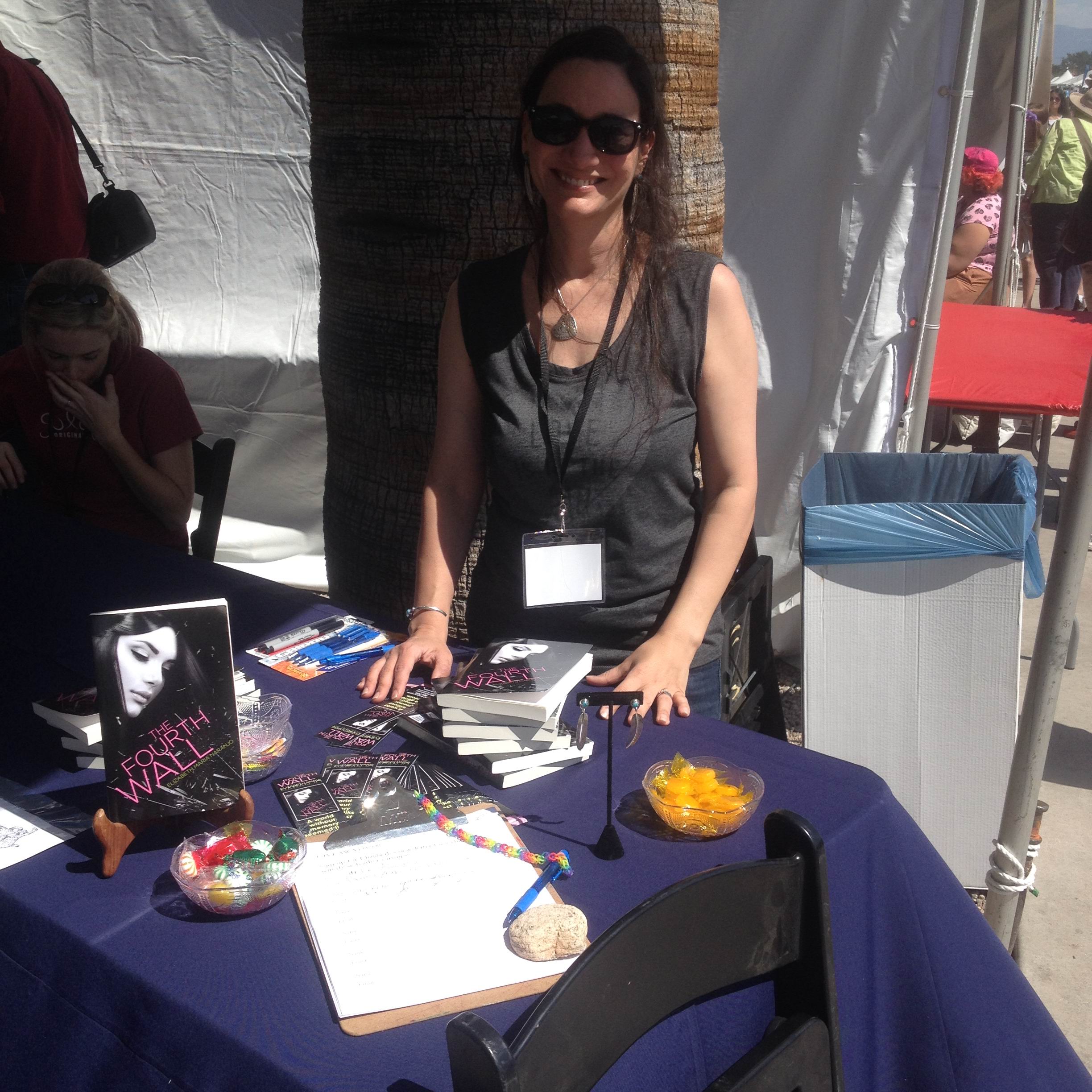
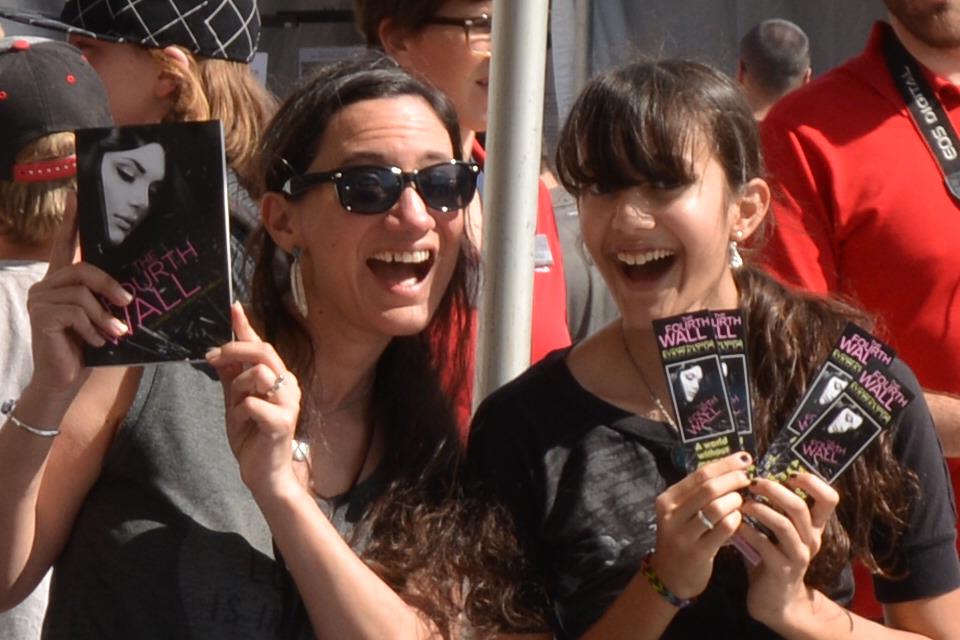
Also…thanks to everyone who came out to the Tucson Festival of Books! And a big welcome to my new subscribers. This was my first time participating in a book festival, and it was a blast. We sold a few books, handed out tons of bookmarks, and discovered organic cotton candy.

Really, that’s a thing.

Here are some pictures, and congrats to R.C. who won the giveaway for my husband’s hand-crafted feather earrings!

photo 2

Tucson Book Festival


Click here to purchase The Fourth Wall on Kindle

Meet Me at the Festival

Tucson Festival author pavilion logo

This Saturday is the perfect day for hanging out at a book festival.

Okay, ANY day is perfect for hanging out at a book festival, but I’ll be signing books at this one and I’d really love to see you. Here are the details; click the link for more information on the TFoB website:

What: Tucson Festival of Books
Where: University of Arizona Campus
When: March 14-15, 9:30 a.m. to 5:30 p.m.
Cost: FREE

*I’ll be at the Children/Teen Author Pavilion on Saturday from 1:00 p.m. to 3:30 p.m. with copies of The Fourth Wall. Also, with plenty of swag and other free stuff. Like candy.

Some of the amazing authors that will be presenting at the festival this year are Jacqueline Woodson, Joyce Carol Oates, Dave Barry, Katherine Paterson, and E. Lockhart. If that’s not exciting enough for you, there will also be churros, root beer floats, gelato popsicles, lemonade, kettle corn, and chili dogs. Something for everyone. 🙂

In other news, a short story of mine called “Four Mile Road” will be published soon in Black Heart Magazine. I’m super excited about that; this one is very special to me and I’m happy that it found a home. I can’t wait to share it with you.

See you on Saturday!

It Only Takes One “Yes”

2043734850_5b73cf0ca3_z

Image from Flickr by jepoirrier

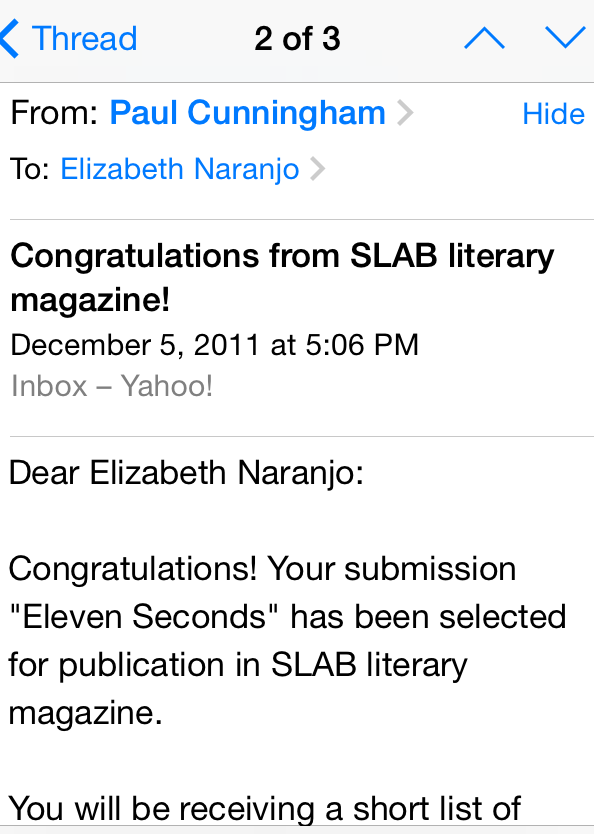
Friday was the anniversary of a pretty special occasion for me. On that day, three years ago, I received my first acceptance letter, for a short story called “Eleven Seconds.”

I will never forget the moment I received that email. It was a cold December evening, and we were gathered around the fireplace. I remember when I saw the subject line I cried out, and Abbey, who was nine years old, thought something was wrong. Then I hugged her and I hugged my son and I hugged my husband. I would have hugged you too, had you been there.

SLAB email

I’d been writing stories since grade school, but it wasn’t until my thirties that I began seriously submitting my work. Sometime after my son was born I just decided to go for it. I decided my dream of turning the title “aspiring writer” into “published author” was a good dream, and it deserved to happen, and the only way it would happen was if I stopped hiding behind the idea of it and actually put my work out there.

So I did, and I spent years collecting rejection slips. They didn’t bother me as much as you’d think. Simply corresponding with editors made me feel as if I were moving forward. It put me in a different category of writers. There are those who think about submitting their work, and then there are those who submit their work. Only writers from the second category get their work published, and the rejections they collect along the way become a kind of badge of honor.

I’d heard that once a writer breaks through, the acceptance letters start coming in pretty regularly. And that was true for me–within a month I had another one, and more would soon follow.

But there will always be rejections. Nearly everything I’ve had published was rejected first.

For example, “Eleven Seconds” was rejected three times. The Fourth Wall was rejected twenty-two times. Don’t worry too much about how many times you hear “No,” because it only takes one “Yes.”

Don’t give up.

Here’s the text of my little story that could, which originally appeared in SLAB literary magazine in the spring of 2012. Read it, if you like, and then go submit one of yours.


ELEVEN SECONDS

It started in the kitchen. A clinking of porcelain, a delicate, dreadful trembling, cups and saucers and unused dinner plates jumping in the cupboards like those little beans from Mexico. What were those called?

Thunder ripped the ground and the old man jerked up from his chair, instinctively, but the fear passed through him like a bullet. His heart fluttered once. He sat back down.

From his seat in the living room, the old man watched his kitchen heave forward and burst apart. The world could shatter around you; he knew that. Bending forward, he plucked a fragment of china from the ground, like a flower. His wife, Winnifred, had painted this piece, before the cancer took her last year. He could see her clearly, her pale knotted hand curled around the thin brush, looping and twirling like a dancer. The old man pressed his hands together and folded them over the broken china, like a prayer.


Thanks for reading!


Book Sales and Royalty Statements

Image from Flickr by Leo Reynolds

Image from Flickr by Leo Reynolds

“So, how are sales going?”

I get this question a lot, along with the more direct “How many books have you sold?” I wish I could tell you. Unfortunately, published authors can’t track their sales in real time.

The only indication I have of how day-to-day sales are going is watching my Amazon rankings, and I have no idea what they mean. I don’t think anyone does, really. The ranking is depicted with a line graph which sometimes spikes, which maybe reflects sales, but you can’t tell how many or where the sales came from.

Other than that, I rely on semiannual royalty statements, and even those don’t tell me much. I can see how many ebooks sold in the prior six-month period and how many books were sold via direct sales (purchased through the publisher’s website) because those sales are final. Distributor sales are different, however; those books are returnable.

For example, for my book launch party at Changing Hands Bookstore, the store purchased 70 copies of The Fourth Wall. Fifty people showed up, half of the copies sold, and the host had me sign an additional 12 copies for the shelves. So that’s 47 books; what happens to the other 13? The bookstore can return them within a certain period of time.

So for my July royalty statement, those 70 copies show as distributor sales, but I don’t get paid yet because the sales are subject to return. My January statement will reflect how many books the bookstore returned, and then I’ll get paid for the remaining sales. Make cents? See what I did there? 😉

Yes, Nielsen BookScan tracks retail print sales which Amazon reports, via Amazon Author Central, on a weekly basis. But that’s not an accurate number; not all retailers use Nielsen BookScan. Amazon estimates the number at 75%.

Anyway, I’m still trying to find an appropriate and satisfying answer to “How many books have you sold?” without burdening my well-meaning friends with the above info. I guess a good answer is this: “More than one and less than a million, but who’s counting?”

Authors, how do you respond?

Happy Halloween, everyone!

Do You See What I See?

Image from Flickr by gradesi

Image from Flickr by gradesi

When a writer publishes fiction, she understands that her work will be interpreted differently by different people. In his book On Writing Stephen King says, “Description begins in the writer’s imagination, but should finish in the reader’s.”

You shouldn’t try to force your reader to see something exactly the way you imagined it.

Which becomes interesting when publishing creative nonfiction. It can be surreal having readers interpret in a different way something that actually happened.

Last week I had a piece published in Brevity Magazine called “Code Talkers.” True to their name, Brevity only publishes essays of 750 words or less. I love writing this way, taking a moment in time—one scene, one turning point—and trying to tell a story based on that moment.

I love allowing readers to imagine the rest of the story.

What struck me about the comments I received on “Code Talkers” was that, although the essay is written from a child’s point of view, several readers perceived it from an adult’s point of view; some even saw the cop as a sympathetic figure.

This is intriguing since part of the story has to do with misunderstandings and assumptions. To the young girl those misunderstandings and assumptions belong to adults, but to adults the misunderstandings would naturally belong to the young girl.

Anyway, I’m blown away by the response to this piece. Thank you to everyone who commented publicly and privately. And to those of you who kindly asked after my brother, he is doing fine. 🙂 We are as close as ever, and we still sometimes talk in code.

To read the essay, click here.

Have you ever written something and had a reader see it differently than you imagined or remembered it?

Are Blog Tours Worth It?

Image from Flickr by manoftaste.de

Image from Flickr by manoftaste.de

This summer I embarked on a national month-long book tour, meeting readers from Missouri, Wisconsin, California, Pennsylvania, and several other places. Of course, it was a virtual book tour–or blog tour–so I saved a lot on gas.

Still, blog tours aren’t cheap, and they’re more work than I ever would have guessed. Now that the tour’s over, several authors have asked me: was it worth it?

As with anything related to book promotion, the answer isn’t simple. It depends on how you measure worth. Many authors understandably measure in numbers, something I try to avoid (and wrote about here). But if you’re curious about the numbers, I tallied a few:

  • Sixteen hosts signed up to participate in the blog tour for The Fourth Wall.
  • Over 900 people entered giveaways for a copy of the book.
  • Dozens of potential readers reached out by leaving comments on blog sites, Facebook and Twitter.
  • Four of my blog hosts reviewed The Fourth Wall and posted their reviews on Amazon and Goodreads.
  • One giveaway winner has already read the book and posted her review on Amazon and Goodreads.
Not bad, right? But there were also surprise outcomes, like an on-going friendship with my tour host (I couldn’t imagine a more perfect pairing; Crystal and I had a blast).

And the fact that having to prepare blog posts about the subjects of my novel and answering pages of interview questions helped renew and focus my passion about the novel’s subjects and themes; it also helped me when it came time for an in-person interview with a local reporter.

Finally, an aspiring writer who visited the first tour stop on WOW! Women on Writing clicked over to my website, found the “classes and critiques” page, and sent an inquiry. She ended up purchasing a critique for her extraordinarily personal memoir, and I was touched and honored.

It’s never easy for a writer to share her work—it takes a great deal of bravery to commit those words to paper let alone place them in the hands of a stranger to be judged. This writer and I worked together on smoothing her essay (it didn’t take much; she’s a fantastic storyteller); I helped her craft a cover letter and she submitted her story, promising to keep me informed. That’s an outcome that can’t be measured.

Ah, but what about the biggie, you wonder. What about book sales?

It’s impossible to tally book sales in relation to the blog tour, even if I could track sales in real time, which I cannot. How would I account for the readers who added The Fourth Wall to their TBR list and purchase it months from now? Those who borrowed it on their Kindle and may later tell a friend? Or the guy researching theater terms, next year, who stumbles across one of the blog posts from the tour? There’s no way to know.

What I do know is I met some wonderful people on my blog tour and had meaningful discussions about writing, publishing, inspiration, music, and dreams (especially lucid ones). I feel like I did something to get the word out about my novel. Which feels pretty great.

And I saved a lot on gas.

Click here to visit the tour.